



Quick Answer: What is Second Impact Syndrome?
Second impact syndrome (SIS) occurs when someone suffers a second concussion or head injury before fully recovering from an initial brain injury. Even a minor second blow can cause rapid, life-threatening brain swelling. Athletes, car accident victims, and anyone with a recent concussion face serious risk.
⚠️ Emergency Warning: If someone with a recent concussion experiences confusion, vomiting, dilated pupils, or loss of consciousness after another head impact, call 911 immediately.
Table of Contents
- What Is Second Impact Syndrome?
- The Biology Behind Second Impact Syndrome
- What Causes Second Impact Syndrome?
- The Eggshell Skull Rule: Your Legal Protection
- Proving Second Impact Syndrome in Court
- What to Do If You Suspect Second Impact Syndrome
- Frequently Asked Questions
- Get Help From Virginia’s Only Board Certified Truck Accident Attorney
For a legal consultation with a personal injury lawyer, call (434) 817-3100
What is Second Impact Syndrome?
Second impact syndrome (SIS) happens when someone suffers a second concussion or head injury before the brain has healed from the first. It’s rare, but when it occurs, the second hit can trigger rapid brain swelling that can be fatal.
Imagine you’re recovering from a concussion after a car accident. You still have occasional headaches, but you feel mostly okay. Then, just two weeks later, you’re in another collision. But this time, just a minor fender bender. You bump your head on the side window. It doesn’t seem like a big deal.
Within minutes, you collapse, and the swelling inside your skull becomes a medical emergency.
This is second impact syndrome.
The second blow doesn’t have to be severe. In fact, what makes SIS so terrifying is that a seemingly minor bump can trigger massive brain swelling within minutes to hours.
Second Impact Syndrome Warning Signs (Call 911):
- loss of consciousness
- repeated vomiting
- worsening headache
- unequal pupils
- slurred speech
- seizures
- confusion / severe disorientation
Key Takeaway About Second Impact Syndrome:
SIS is rare and some experts debate diagnostic criteria. What’s not debated is that a second concussion before recovery can be catastrophic. It is critical to have adequate concussion recovery time.
Have you or a loved one suffered multiple head injuries close together? Understanding SIS could save your life and protect your legal rights. You may have grounds for a catastrophic brain injury lawsuit.
For more information about brain injury cases, please visit our article, The Complete Guide to Traumatic Brain Injury Cases in Virginia. You may also be interested in What to Expect When Pursuing a Brain Injury Claim in Virginia.
The Biology Behind Second Impact Syndrome: What Happens in Your Brain
Understanding the biological mechanism of SIS helps explain why it’s so dangerous, and why victims deserve full compensation for these devastating injuries.
Stage 1: The Initial Injury (First Concussion)
When you suffer your first concussion, your brain undergoes what doctors call a “metabolic crisis”:
Neurochemical Chaos:
- Potassium floods out of brain cells
- Calcium floods into brain cells
- Neurotransmitters (brain chemicals) release uncontrollably
- Brain cells fire randomly and excessively
Energy Crisis:
- Your brain’s glucose metabolism becomes impaired
- Brain cells cannot produce enough energy (ATP)
- Cells struggle to restore normal ion balance
- Blood flow to the brain decreases (called “hypoperfusion”)
During this period, your brain is extraordinarily vulnerable. Even though you might feel “okay” after a few days, your brain cells are still in crisis mode. They are desperately trying to restore normal function while operating with limited resources.
This metabolic crisis typically lasts 7-10 days in mild concussions, but can persist for weeks or months in moderate to severe brain injuries.
Stage 2: The Second Impact
When a second blow occurs during this vulnerable period, your already-compromised brain cannot handle the additional stress.
The Vascular Catastrophe:
Within minutes to hours of the second impact, the body’s normal control of brain blood flow can fail:
- Autoregulation fails: Your brain normally controls its own blood flow through a process called autoregulation. After the first injury, this system is already impaired. The second impact causes complete failure.
- Blood vessels dilate massively: Without working autoregulation, blood vessels in the brain open wide (dilate) uncontrollably.
- Blood floods brain tissue: This vascular engorgement causes immediate, severe swelling.
- Intracranial pressure skyrockets: As blood floods the brain, pressure inside your skull increases rapidly.
Stage 3: The Herniation Cascade
As intracranial pressure rises, the brain begins to herniate. That means that brain tissue gets pushed through openings in the skull or between brain compartments.
Types of herniation in SIS:
- Uncal herniation: The temporal lobe pushes through the tentorial opening, compressing the brainstem
- Tonsillar herniation: The cerebellum pushes down through the foramen magnum (the opening at the skull base), crushing the brainstem
When your brainstem gets compressed, it cannot control vital functions:
- Breathing stops or becomes irregular
- Heart rate becomes unstable
- Blood pressure drops
- Consciousness is lost
This is why SIS is can be fatal or permanently disabling, even with rapid treatment. By the time doctors recognize what’s happening and attempt emergency surgery, the brainstem damage is already done.
Why Young Athletes Are Most Vulnerable
People under age 25 are at highest risk for SIS because:
- Their brains are still developing (full maturation occurs around age 25)
- They have higher baseline brain metabolism
- Their autoregulation systems are not fully mature
- They often minimize symptoms to return to sports
In one study of documented SIS cases, 91% occurred in people under age 20, and most were athletes who returned to competition too soon after an initial concussion.
Does this biological explanation sound complicated? Here’s what it means for you: If someone caused your first brain injury, and you suffered a second impact during your recovery period, they’re legally responsible for all resulting harm — including SIS. That’s the law in Virginia, and it’s called the eggshell skull rule.
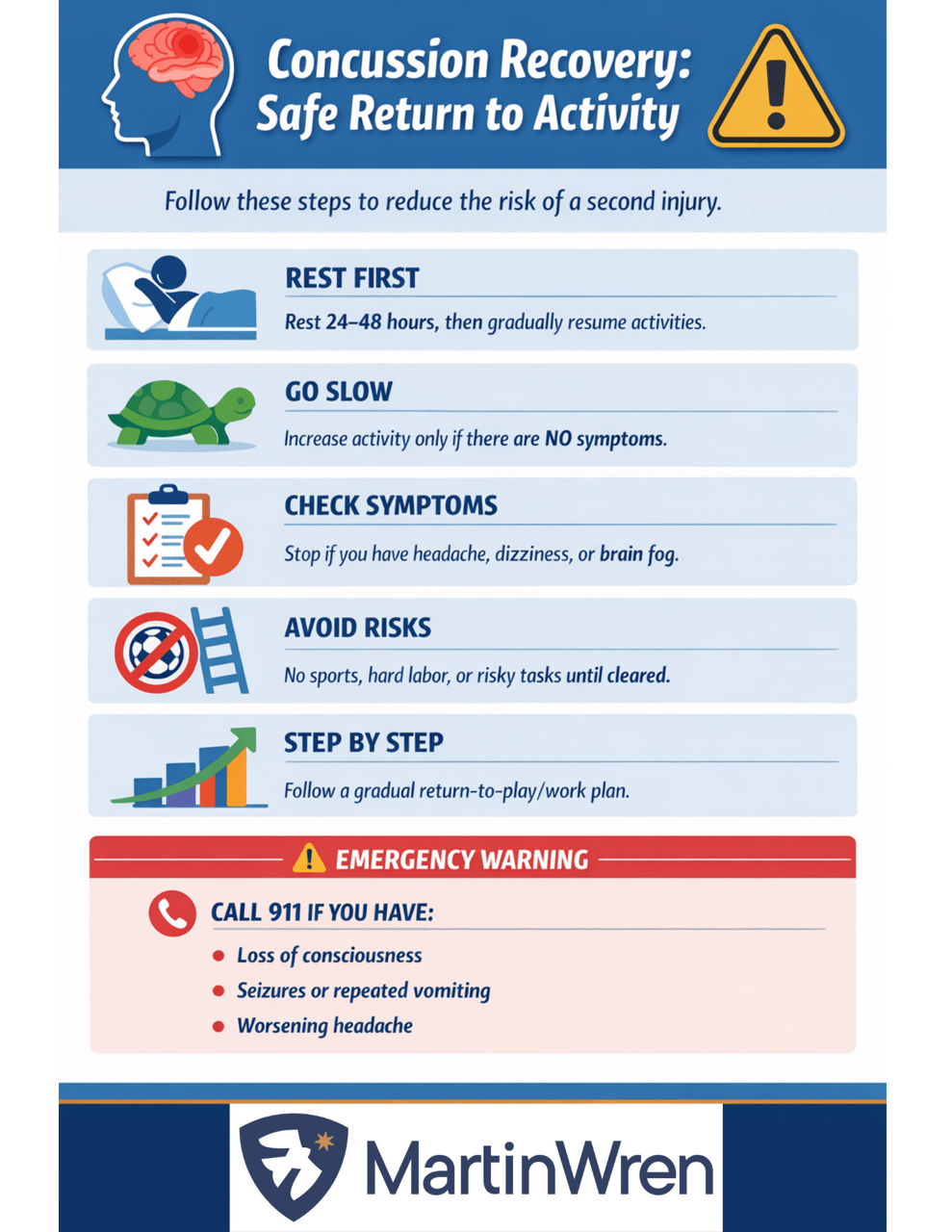
Concussion recovery checklist: Follow these steps to reduce the risk of a second injury and recognize emergency warning signs that require immediate medical care.
What Causes Second Impact Syndrome?
Second impact syndrome requires two elements:
- An initial concussion or traumatic brain injury that hasn’t fully healed
- A second head injury during the vulnerable recovery period
The first injury creates the dangerous metabolic state in your brain. The second injury triggers the vascular catastrophe.
The First Injury: Setting the Stage
Your initial brain injury can come from any traumatic event:
Motor Vehicle Accidents:
In Virginia, motor vehicle accidents are the leading cause of traumatic brain injury in adults. If you hit your head on the steering wheel, windshield, or side window in a crash, you may have suffered at least a mild concussion.
Falls:
- Slip and fall accidents
- Trip and fall incidents
- Falls from heights
- Falls down stairs
Falls are particularly common in premises liability cases, construction accidents, and among elderly victims.
Workplace Accidents:
- Objects falling on your head
- Being struck by equipment
- Falls from scaffolding or ladders
- Forklift accidents
Many Virginia workers in construction, manufacturing, and warehousing suffer concussions that go undiagnosed or unreported.
Sports Injuries:
- Football tackles
- Soccer headers or collisions
- Basketball collisions
- Wrestling impacts
Assault:
- Blows to the head
- Being thrown against walls or floors
- Domestic violence
The Second Injury: The Trigger
The second impact that triggers SIS doesn’t have to be severe. Documented cases include:
- A minor car accident after a previous crash
- A routine tackle in football practice
- Tripping and bumping your head on a counter
- A ball hitting you in the head during practice
- A minor fall while still recovering
This is crucial for your legal case: Many insurance companies will try to argue that the second impact was “too minor” to cause serious injury. But medical science proves that even a minor blow can trigger catastrophic brain swelling when someone hasn’t healed from their first injury.
Have you suffered two head injuries within weeks of each other? The timing and circumstances matter enormously for both your medical treatment and your legal rights.
Click to contact personal injury lawyers today
The Eggshell Skull Rule: Your Legal Protection in SIS Cases
Here’s the most important legal principle you need to understand about second impact syndrome:
In Virginia, the person who caused your initial brain injury is legally responsible for ALL resulting harm — even if your pre-existing condition or vulnerability made you more susceptible to severe injury.
This is called the “eggshell skull rule” (also known as the “thin skull rule” or “eggshell plaintiff rule”).
What Is the Eggshell Skull Rule?
The eggshell skull rule says:
“A defendant must take their victim as they find them.”
In plain English: If someone injures you through negligence, they’re liable for all consequences of that injury — even if a typical person would have suffered less harm.
How the Eggshell Skull Rule Works
Think of it this way:
You have a medical condition that makes your skull abnormally thin, like an eggshell. Someone punches you in the head. A person with a normal skull would get a bruise. But because of your thin skull, you suffer a catastrophic brain injury.
Is the attacker off the hook because you were more vulnerable?
Absolutely not. They’re liable for the entire injury, including the catastrophic harm made worse by your pre-existing condition.
The rule applies even when:
- The defendant didn’t know about your vulnerability
- Your vulnerability was unusual or unexpected
- A “normal” person wouldn’t have been injured as badly
- Your pre-existing condition was genetic, developmental, or from a prior injury
Proving Second Impact Syndrome in Court: Building Your Case
Second impact syndrome cases are medically and legally complex. Here’s what it takes to prove SIS and recover full compensation in Virginia.
What You Must Prove
To win a second impact syndrome case, you must establish:
1. Defendant’s Negligence
You must prove the defendant who caused your initial injury was negligent:
- They owed you a duty of care
- They breached that duty
- Their breach caused your initial brain injury
2. Initial Brain Injury
You need medical evidence of your first concussion or TBI:
- Emergency room records
- CT or MRI scans
- Concussion diagnosis
- Documented symptoms (headaches, dizziness, confusion, memory problems)
3. Incomplete Recovery
You must show your brain hadn’t healed before the second impact:
- Ongoing symptoms between injuries
- Medical records showing continued complaints
- Timeline showing insufficient healing time
- Expert testimony about metabolic crisis duration
4. Second Impact
Documentation of the second head injury:
- Accident reports
- Witness testimony
- Medical records from second incident
- Timeline showing proximity to first injury
5. Causation
Medical evidence linking SIS to the initial injury:
- Diagnostic imaging showing brain swelling pattern consistent with SIS
- Medical records documenting rapid neurological decline after second impact
- Expert testimony explaining SIS mechanism
- Proof that SIS wouldn’t have occurred without the vulnerable state created by first injury
Complete a Case Evaluation form now
Critical Evidence in SIS Cases
Medical Records:
- All emergency room visits
- Hospitalization records
- Neurological consultations
- Neuropsychological testing
- Diagnostic imaging (CT, MRI)
- Surgery reports
- Rehabilitation records
Expert Witnesses:
- Neurologist or neurosurgeon to explain SIS mechanism
- Neuroradiologist to interpret imaging studies
- Life care planner to calculate future medical needs
- Economist to calculate lost earning capacity
- Vocational rehabilitation expert to assess disability
Timeline Evidence:
- Accident reports for both incidents
- Medical appointment dates
- Symptom diaries or journals
- Work absence records
- Text messages or emails discussing symptoms
- Social media posts (showing activity limitations)
Witness Testimony:
- Family members who observed symptoms between injuries
- Coworkers who noticed changes
- Coaches or trainers who saw the incidents
- Emergency responders
- Treating physicians
Common Defense Strategies (And How We Counter Them)
Insurance companies that face a catastrophic brain injury lawsuit will pull out a number of tactics to try to undermine the claim.
Defense Strategy 1: “The First Impact Caused All the Harm”
Insurance companies love to argue that the initial injury was major and the second impact did not contribute to the severe damage.
Our Counter:
- Medical testimony explaining SIS mechanism — the second impact alone wouldn’t cause catastrophic injury without the vulnerable state from the first injury
- Eggshell skull rule — even if true, the first defendant is liable for making you vulnerable
- Biomechanical analysis showing second impact was insufficient to cause such severe injury in a healthy brain
Defense Strategy 2: “Pre-Existing Conditions Caused Vulnerability”
If you had any prior head injuries or conditions, defense will argue these — not the first injury — made you vulnerable to SIS.
Our Counter:
- Medical records showing you functioned normally before the first injury
- Eggshell skull rule applies to ALL pre-existing vulnerabilities
- Expert testimony that the immediate temporal relationship between first injury and SIS proves causation
- Even if prior injuries contributed to vulnerability, first defendant is still liable under eggshell skull rule
Defense Strategy 3: “The Victim Failed to Mitigate Damages”
Defense may argue you should have:
- Sought immediate treatment after first injury
- Followed all medical recommendations
- Avoided risky activities during recovery
- Been more careful
Our Counter:
- Virginia law places burden on defendant, not victim, to avoid harm
- Many concussion symptoms are subtle; victims often don’t realize severity
- Defendant created dangerous condition; victim not required to live in isolation
- Comparative negligence analysis (if applicable) only reduces damages; doesn’t eliminate liability
The Challenge of Proving SIS in Mild Cases
One of the hardest aspects of SIS cases is that the initial injury may have seemed minor. You might not have even sought treatment immediately. You thought you were “fine.”
This is actually very common. And we can work with it.
Here’s how:
- Subtle symptoms still count: Headaches, dizziness, irritability, fatigue, sleep problems — these are concussion symptoms even if they seem minor
- Delayed treatment is explainable: Many people don’t realize they have a concussion. This doesn’t mean it didn’t happen.
- Circumstantial evidence helps: If you hit your head in the first accident, and medical science shows the impact was sufficient to cause concussion, we can establish brain injury even without immediate diagnosis
- Medical experts can reconstruct: Neurologists can review both incidents and give retrospective opinions about when initial injury occurred and whether brain had healed
- The second injury proves the first: The fact that a minor second impact caused catastrophic SIS is itself evidence that your brain was compromised from the first injury
Why You Need a Specialized Attorney
Second impact syndrome cases require:
- Understanding of complex neuroscience and brain injury mechanisms
- Ability to work with specialized medical experts
- Experience with eggshell skull rule and causation arguments
- Resources to fully investigate and document both incidents
- Trial skills to explain complicated medicine to a jury
As Virginia’s only Board Certified Truck Accident Attorney, I’ve handled numerous catastrophic brain injury cases involving complex causation issues. I work with leading neurologists and neurosurgeons who can definitively prove SIS and establish the link to your initial injury.
Don’t let an insurance company tell you your case is “too complicated” or that you can’t prove your injuries are related. With the right legal and medical team, we can build a winning case.
What to Do If You Suspect Second Impact Syndrome
If you or a loved one might have second impact syndrome, time is critical — both medically and legally.
Immediate Medical Steps
If Someone Shows SIS Warning Signs, Call 911 Immediately:
- Rapid deterioration after second head impact
- Loss of consciousness
- Severe confusion or disorientation
- Dilated pupils (unequal pupil sizes)
- Slurred speech
- Inability to recognize people or place
- Vomiting
- Seizures
- Difficulty breathing
- Loss of reflexes
At the Hospital:
Tell emergency responders and doctors:
- There was a recent prior head injury (even if it seemed minor)
- When the first injury occurred
- What symptoms persisted between injuries
- Exactly what happened during the second impact
This information is critical for rapid diagnosis and treatment.
If You’ve Had Two Recent Head Injuries But Feel “Okay”
See a neurologist immediately even if you don’t have severe symptoms. You need:
- Complete neurological examination
- Brain imaging (CT or MRI)
- Assessment of cognitive function
- Clear medical documentation of your condition
Do not:
- Return to sports, work, or activities where another head injury could occur
- Drive (impaired reaction time puts you and others at risk)
- Drink alcohol (worsens brain injury)
- Take sleep medications or sedatives without doctor approval
- Assume you’re “fine” because symptoms seem mild
Legal Steps to Protect Your Rights
1. Document Everything
- Take photos of any visible injuries, vehicle damage, accident scenes
- Write down exactly what happened in both incidents (dates, times, locations, who was involved)
- Keep a symptom diary tracking headaches, dizziness, memory problems, mood changes
- Save all medical records, bills, prescription receipts
2. Preserve Evidence
- Get police reports from both incidents
- Collect witness contact information
- Save text messages, emails, or social media posts discussing symptoms
- Keep work absence records or school attendance records
- Don’t repair vehicle damage until it’s been photographed and evaluated
3. Don’t Talk to Insurance Companies Alone
Insurance adjusters will try to:
- Get you to downplay your first injury
- Blame the second impact for all your problems
- Rush you into a quick, low settlement
- Record statements that hurt your case
Say this: “I need to speak with my attorney before discussing the accident.”
4. Contact a Brain Injury Attorney Immediately
SIS cases involve complex medical and legal issues. You need an attorney who:
- Understands traumatic brain injury and second impact syndrome
- Has access to top medical experts
- Has successfully handled complex causation cases
- Won’t back down against insurance companies
Time limits apply. In Virginia, you generally have two years from the date of injury to file a lawsuit — but investigation and expert retention take time. The sooner you contact an attorney, the better we can preserve evidence and build your case.
What to Expect When You Call Our Firm
When you contact MartinWren, P.C. for a second impact syndrome case:
Free Case Review:
- We listen to your story
- We review your medical records
- We explain your legal rights
- We answer all your questions
- You pay nothing for this consultation
If We Take Your Case:
- We work on contingency (you pay no attorney fees unless we win)
- We advance all case costs (expert witnesses, medical records, investigation)
- We handle all communication with insurance companies
- We bring in the medical experts needed to prove SIS
- We fight for maximum compensation for your lifetime needs
Our Investigation Includes:
- Obtaining all medical records from both incidents
- Consulting with neurologists and neurosurgeons
- Reconstructing both accidents if needed
- Interviewing witnesses
- Reviewing employment records, wage loss, and future earning capacity
- Working with life care planners to calculate lifetime medical costs
Frequently Asked Questions About Second Impact Syndrome
How long after a concussion can you get second impact syndrome?
Second impact syndrome typically occurs within 7-10 days of the initial concussion, when the brain’s metabolic crisis is at its peak. However, SIS can develop weeks or even months after the first injury if the brain hasn’t fully healed.
The risk is highest in the first two weeks but continues until all concussion symptoms have resolved AND the brain has completed its metabolic recovery — which can take 6-12 weeks for moderate concussions.
Bottom line: If you’ve had a head injury in the past several weeks — especially if symptoms are ongoing — you may still be vulnerable to serious complications from another impact.
Can you survive second impact syndrome?
SIS can be fatal in minutes to hours. Medical literature suggests that the mortality rate for documented SIS cases can be high, but the actual mortality rate of SIS is unknown.
Among survivors, many can suffer permanent neurological damage, including:
- Seizure disorders
- Cognitive deficits (memory, concentration, processing speed)
- Motor impairments (weakness, coordination problems)
- Vision problems
- Personality changes
- Chronic headaches
Even with the best medical care, SIS can result in either death or devastating lifelong disability.
How is second impact syndrome diagnosed?
SIS is diagnosed based on:
Clinical History:
- Recent prior head injury (within weeks)
- Second impact (often minor)
- Rapid neurological deterioration within minutes to hours
Symptoms:
- Immediate collapse or loss of consciousness after second impact
- Rapidly decreasing level of consciousness
- Dilated pupils
- Loss of eye movement
- Respiratory distress
Imaging:
- CT scan showing diffuse brain swelling
- Loss of normal brain structures due to swelling
- No significant focal injury (like a large bleeding area) to explain severity
- Pattern consistent with vascular engorgement
Differential Diagnosis:
Doctors must rule out other causes of rapid brain swelling:
- Epidural hematoma (bleeding outside the brain)
- Subdural hematoma (bleeding under the skull)
- Brain contusion (bruising)
- Diffuse axonal injury
The key distinguishing features of SIS are:
- Prior recent head injury
- Rapid onset after second (often minor) impact
- Diffuse swelling without major bleeding or contusion
- Catastrophic outcome from seemingly minor second blow
What is the difference between second impact syndrome and chronic traumatic encephalopathy (CTE)?
These are completely different conditions. In short, SIS is an acute, life-threatening emergency from two impacts. CTE is a progressive, long-term brain disease from many impacts over years.
Can second impact syndrome happen without loss of consciousness?
The initial concussion often occurs without loss of consciousness. You can suffer a significant brain injury and never black out.
However, the second impact in SIS almost always causes rapid loss of consciousness as brain swelling and intracranial pressure increase. This collapse is one of the hallmark signs of SIS.
If someone with a recent head injury suffers a second impact but remains conscious and alert, they likely don’t have SIS — though they should still be evaluated immediately by a neurologist.
Who is most at risk for second impact syndrome?
Highest Risk Groups:
Young athletes (under age 25):
- Brains still developing
- Often return to sports too quickly
- May hide symptoms to keep playing
- Football, hockey, soccer, wrestling, basketball players
People recovering from recent concussion:
- Anyone still having symptoms (headaches, dizziness, confusion)
- Anyone who hasn’t been medically cleared
- People who suffered concussion within past 6-12 weeks
Accident victims:
- Car accident survivors during recovery period
- Truck accident victims
- Motorcycle crash survivors
- Fall victims
People with multiple prior concussions:
- History of brain injury makes recovery slower
- Cumulative effects increase vulnerability
- Even “old” concussions can extend recovery time
People who don’t seek treatment:
- Undiagnosed concussions are still vulnerable
- Without medical guidance, return to risky activities too soon
How much is a second impact syndrome case worth?
It is important to understand that every case is different. Case value depends on many things, so it is impossible to say exactly what a case is worth. The value of a SIS case depends on:
Economic Damages:
- Lifetime medical care (often $5-20 million for severe SIS) (Note: These figures are illustrative only; the value of any case depends on the specific facts, liability, causation, and available insurance or assets, etc.)
- Lost wages and lost earning capacity (calculated over lifetime)
- Rehabilitation costs
- Home modifications for disability
- Assistive equipment and devices
Non-Economic Damages:
- Pain and suffering
- Loss of quality of life
- Disability and disfigurement
- Mental anguish
- Loss of consortium (for family members)
Your case’s value depends on:
- Severity of your injuries
- Your age (younger victims have longer lifetime needs)
- Your pre-injury earning capacity
- Available insurance coverage
- Strength of liability proof
What is the eggshell skull rule and how does it apply to my case?
The eggshell skull rule (covered in detail above) says: The defendant who caused your initial injury is liable for all resulting harm — even if your pre-existing condition or vulnerability made you more susceptible to severe injury.
How it protects you in SIS cases:
- The first defendant can’t blame the second impact for your injuries
- You don’t have to prove you were “average” or “healthy” before injury
- Your damages aren’t reduced because you were more vulnerable than others
- The defendant must pay for all consequences of the dangerous condition they created
Example: If a truck driver’s negligence gave you a concussion, and two weeks later you developed SIS after a minor fall, the truck driver is liable for all your SIS injuries — including lifetime medical care, disability, and lost earnings — even though the fall triggered the syndrome.
This is THE most important legal protection for SIS victims in Virginia.
Get Help From Virginia’s First Board Certified Truck Accident Attorney
Second impact syndrome cases are among the most complex and devastating brain injury claims. You need an attorney who:
- Understands the neuroscience of SIS and can explain it to a jury
- Has successfully handled catastrophic brain injury cases
- Works with leading medical experts nationwide
- Knows how to maximize compensation under the eggshell skull rule
- Won’t back down against insurance companies
I’m Bob Byrne, and I’ve dedicated my career to helping catastrophic injury victims and their families fight for justice. As the only Virginia-based Board Certified Truck Accident Attorney through the National Board of Trial Advocacy, I have the specialized knowledge and resources to handle even the most complex SIS cases.
When you work with MartinWren, P.C.:
✓ Free case review — no obligation, no cost ✓ No attorney fees unless we win — we work on contingency ✓ We advance all costs — experts, medical records, investigation ✓ Access to top medical experts — neurologists, neurosurgeons, life care planners ✓ Personalized attention — you work directly with me, not a paralegal ✓ Maximum compensation — we fight for full value of your lifetime needs
Take Action Now
If you or a loved one has suffered second impact syndrome, or if you’re concerned about multiple head injuries close together, contact our Charlottesville personal injury legal team immediately. Our experienced Charlottesville brain injury lawyer can help.
Or fill out our contact form for a free, confidential case review.
Time is critical. Evidence fades, witnesses forget, and legal deadlines approach. The sooner we start investigating your case, the better we can protect your rights and secure the compensation you deserve.
Don’t let an insurance company minimize your injuries or blame you for your vulnerability. You have rights under Virginia law — and we’ll fight to enforce them.
Virginia’s most serious brain injuries deserve Virginia’s specialized legal representation.
Related Resources
Learn more about traumatic brain injury:
- Complete Guide to Traumatic Brain Injury in Virginia
- Concussion Symptoms: Signs You May Have a Brain Injury Claim
- Open v. Closed Head Brain Injuries: Know the Critical Differences
- What to Expect When Pursuing a Brain Injury Claim in Virginia
Other catastrophic injuries we handle:
- Understanding Spinal Cord Injuries: A Comprehensive Guide for Virginia Accident Victims
- Virginia Wrongful Death Claims: Information for Families Who Lost a Loved One
- Back Injuries After an Accident: Types, Treatment, and Making a Claim in Virginia
This article is for general information and is neither medical advice nor legal advice. If you suspect a concussion or SIS, seek emergency care. To understand your legal rights, contact us today.
Updated by Bob Byrne on August 12, 2026.
Call (434) 817-3100 or complete a Case Evaluation form